The earth as tomb and womb
The Master Butchers Singing ClubThe earth as tomb and womb is a recurring image that makes the ground at once a repository of grief and a place from which life may begin again. Its clearest development follows Markus, who, a year after Eva’s death, digs himself a sheltered hollow in an abandoned construction mound, is buried when it collapses, and emerges into an illness Delphine interprets as a kind of gestation. The image also reaches beyond his story: hidden death is released from a cellar, and a wooded prisoner-of-war camp becomes a place of nourishment. In each instance, entering the earth changes what can be remembered, endured, or carried forward.
The Mound as a Place of Grief
A year after his mother’s death, Markus discovers an unfinished building site behind the woods, where a planned house has left an excavated basement, a heap of earth, and an abandoned shed. The place first draws him through the ordinary appeal of abandoned objects: he explores the basement, finds a broken ax head, and climbs the raw mound. When the earth seems to shift beneath him, the sensation pleases him. The mound feels alive, even before he has made it into shelter.
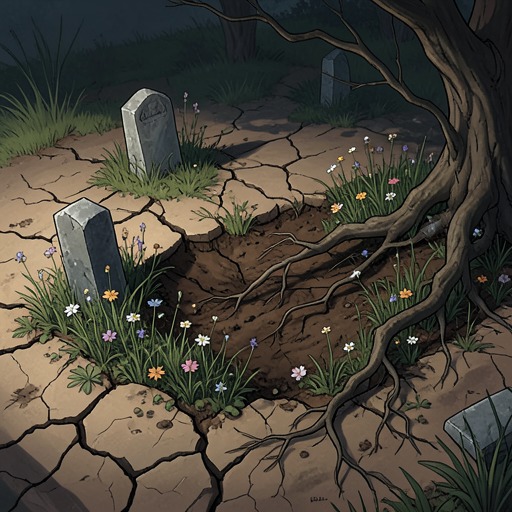
His grief appears there without warning. Markus cries alone, as he has often done since Eva died, and remembers the burial: he had frozen with a clump of dirt in his hand instead of releasing it onto his mother’s coffin. Franz had opened his fingers and shaken the earth down for him, then led him away without speaking. The memory gives the mound a double meaning. It is made of the same material as the grave, but here Markus can enter it by choice and stay.
At the hill’s base, he presses his ear to the packed earth and hears his own heartbeat. He begins digging with the ax head, making a hollow large enough for his shoulder and then his head. As the space grows into a shallow, bowl-shaped den, he imagines somewhere he can fit. Snail shells and tiny clamshells are embedded in the dark soil; clods fall from the roof, and he pushes them aside. When he backs beneath the overhang and sits in the soft earth, he is hungry but reluctant to leave. He recognizes that there will be a next time: the hollow has become a project and a place to return to.
From Private Hollow to Hidden Fort
The den gives Markus a brief experience of comfort and anticipation that he associates with the happier summers and holidays before Eva became ill. He sleeps in the hollow and wakes with a feeling that something good is waiting to be found if he keeps digging. The earth does not erase his grief; it gives him a protected space in which grief and expectation can occupy the same moment.
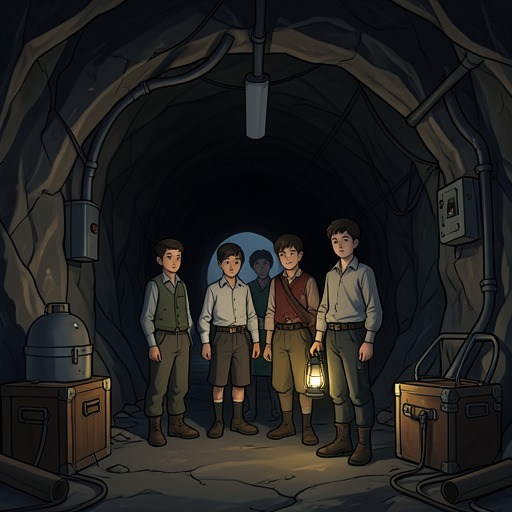
Markus soon tells Emil and Erich about the site. His private hollow becomes a shared underground fort, imagined as a tunnel or stronghold that the boys can reinforce with boards from the abandoned shed and branches from the woods. Markus proposes an oath of secrecy, sealed with hot wax on the inside of their wrists. The boys steal shovels, use sheets to haul dirt, and cache food for their work after school. What began as a place to be alone with sorrow becomes a concealed world organized around companionship, labor, and play.
The fort’s shelter is precarious. When Markus stays inside to reinforce the passage after the others have gone to fetch another board, the mound suddenly sags and takes him in. The boys outside realize only after several minutes that he is still underground. The earth that had offered him a den and a promise of future work now closes over him, turning chosen enclosure into involuntary burial.
Burial, Rescue, and Rebirth
Trapped beneath the collapsed hill, Markus is wedged under buckled boards. He is unable to move, but he is not immediately aware of the danger as the others understand it. His thoughts return to being a small child when his fever broke and Eva curled around him in blankets, holding his forehead. In the darkness, the earth’s enclosure recalls maternal shelter: he imagines his mother’s comforting presence and feels himself rocked in a silent, enclosed world.
Cyprian recognizes that rescuers must work carefully. He enters the narrowing tunnel and manages his fear by attending to one breath at a time, drawing on the discipline he learned in dangerous situations. Finding Markus alive, he removes the soil in small handfuls rather than risk another collapse. He works limb by limb, turns the boy, and folds him through the small opening. When he finally brings Markus out, Delphine receives him. The rescue makes the earth’s two capacities inseparable: it has nearly become a grave, but the passage through it ends in the hands of people who can bring Markus back to the surface.
Markus falls ill afterward, with a broken arm and a feverish, sleepy state that Delphine calls earth sickness. She imagines the cold ground still drawing him toward the place where Eva lies, but gradually revises her understanding. His distant stare seems less like death’s hold than the regard of a newborn. She stops trying to divert him with poems and games, deciding that he needs time to think and grow back into his life. She nurses him with dumpling soup Eva had taught her to make, encourages him to sit in the sun, and keeps him near the light when frost settles in the garden. The language of burial gives way to gestation: Markus is not simply returning unchanged from the hill, but emerging from an inward passage.
Hidden Death and the Earth’s Wider Meaning
The image also appears in the cellar Delphine and Cyprian open. They chip through a seal made of shattered jars, dog droppings, and red beads set into peach juice, then force up the floor hatch. The first smell they had struggled against proves to be only a shadow of what lies below; the real odor drives them out of the house and into the yard. The cellar acts as a concealed chamber in which the past has remained physically closed off. Breaking its seal does not resolve what happened there; it makes the hidden horror impossible to ignore.
Roy’s later account connects that hidden space to the death of Ruthie Chavers and her family. He remembers yelling down to Chavers that he could come back up after he stopped singing over him at practice, and wonders whether he shut the hatch. His recollection does not settle every uncertainty, but it links the sealed cellar to an act of negligence or harm that had been buried in silence. Here the ground and the space beneath a house do not shelter a new beginning: they conceal the consequences of the past until someone opens the door.
A different form of enclosure appears when Erich reaches a prisoner-of-war camp deep in the woods. Pine logs and wire mark the camp’s boundaries, but the surrounding trees and open sky make it less forbidding than he expected. He receives work clothes, blankets, shoes, and other necessities, then eats a hot meal of familiar baked beans, corn, potato, and cornbread. The prisoners understand from the quantity and quality of the food that Germany has lost the war. The camp remains a place of confinement, yet its wooded setting and provisions make it a place where a prisoner can be sustained. Across these scenes, the earth is not a single symbol with a fixed meaning. It can hold a grave, a child’s refuge, an underground danger, or a guarded camp; what matters is who enters, what the place conceals, and whether anyone can return from it.
The Image’s Pattern
The mound’s changing meaning gives physical form to a passage through grief. Markus first approaches the earth as a place that feels alive, then uses it to make a private shelter, loses control of it when the hill collapses, and finally recovers through the care of others. His burial recalls the death of Eva, while his recovery invites Delphine to understand the episode as a new beginning rather than a final descent. The earth does not undo loss or promise that suffering will end. It provides the image through which the novel holds together the proximity of burial and birth, silence and memory, danger and care.
The other enclosed spaces complicate that pattern. The cellar’s sealed hatch keeps an old death hidden, whereas the fort’s opening becomes a route through which Markus can be brought back. The camp’s boundaries signify captivity, but within them food and work allow Erich to recognize defeat and endure its immediate aftermath. The recurring image therefore resists a simple opposition between safe ground and dangerous ground. Earth can receive, conceal, compress, and sustain; its meaning changes with the histories carried into it and with the possibility of emergence.